ai
Rail Levels: The Levels of AI Agent Autonomy, From Read-Only to Bounded Action
Levels of AI agent autonomy describe how much an agent may do before a person steps in. For customer data we use five: off, read, propose, execute after approval, and act within bounds. Levels belong to a job, not to an agent or a company, and every move up needs written evidence. The ladder applies to any customer data platform (CDP).
By Art Kukharenko · Published · Updated
All AI agent railsWho this is for: heads of marketing operations, risk and AI governance leads, and architects. You will be able to set a maximum level for each job, write promotion and demotion rules, and design approvals that do not decay into rubber-stamping. This page is part of the AI agent rails method.
What are the five rail levels?
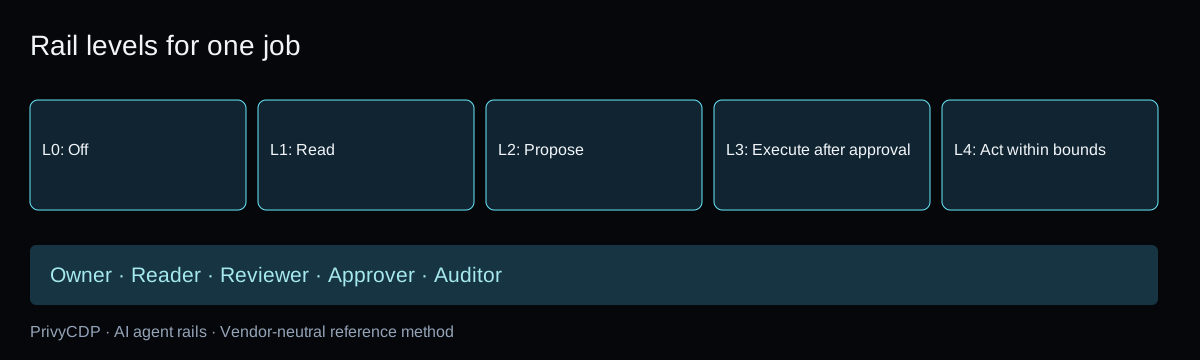
Five rail levels set what the agent may do and what the person does. Each one sits on a stage of the AI marketing operations roadmap.
Scroll horizontally to see all columns.
| Level | Name | The agent may | The person is | Roadmap stage |
|---|---|---|---|---|
| L0 | Off | Nothing; the job is manual | Owner | Stage 1 |
| L1 | Read | Read masked data or aggregates, summarise, answer questions | Reader who checks | Stage 2 |
| L2 | Propose | Draft or recommend; nothing changes | Reviewer who accepts or rejects | Stage 2 |
| L3 | Execute after approval | Execute one named action after a named person approves the diff | Approver | Stage 3 |
| L4 | Act within bounds | Act alone on low-risk, reversible actions within written limits, with auto-revert | Auditor | Stage 4 |
The ladder stops at L4. Promotion needs written evidence and owner sign-off. Demotion is automatic on triggers: error budget breached, serious escaped error, drift alert, open incident, a model or tool change without a regression pass, no named owner.
Above L4, an agent would act across a broad scope or set its own goals, and we do not recommend that for customer data. The Cloud Security Alliance's scale goes higher, but its author says of the top level that "the control mechanisms required to safely operate at this level don't exist yet" 1.
Most work never needs the top rung. In our roster of 33 agents, 25 never go above L2. The five that reach L4 do so for one narrow action each: pausing a send, pausing a stream, raising a hold, retrying an approved sync and routing a request.
View or embed this diagram as SVG
How does this compare with other autonomy scales?
No standard scale for agent autonomy exists, so level numbers from different publishers do not line up. The crosswalk below is our own reading of two published scales and the common loop terms. Neither publisher has reviewed it.
Scroll horizontally to see all columns.
| This ladder | Cloud Security Alliance (Reavis, 2026) 1 | Feng, McDonald and Zhang (2025) 2 | Loop term |
|---|---|---|---|
| L0 Off | No equivalent: no AI in the job | No equivalent | No agent, no loop |
| L1 Read | Level 0: AI informs, humans act | L1 operator: the user directs and the agent helps on demand | Human in the loop |
| L2 Propose | Level 0: AI recommends, humans act | L1 operator: the agent suggests and does not execute until approved | Human in the loop |
| L3 Execute after approval | Level 1: approve each action. Level 2 only when the batch is named and bounded | Closest to L1 operator. Their L4 approver shares the word, but lets the agent work alone between sign-offs | Human in the loop |
| L4 Act within bounds | Level 3: acts within boundaries and escalates | L5 observer in the person's role: logs and an off-switch. Ours covers one narrow action, not all tasks | Human on the loop |
| No equivalent | Level 4 high autonomy; Level 5 full autonomy | L2 collaborator and L3 consultant: shared or agent-led planning across tasks | Human out of the loop |
Watch the numbers when you read across. CSA Level 1 is our L3, and CSA Level 3 is our L4. Our L1 and L2 both sit at CSA Level 0. Feng's L4 is not our L4.
The scales also measure different things. Feng and colleagues name the roles a user can take, and treat autonomy as a design choice separate from capability. We share that view: a capable model can still sit at L1. The CSA post counts how far decisions move to the AI, and its author offers it for discussion rather than as a finished standard.
The loop terms are common usage, not legal definitions. Human in the loop means a person acts before anything takes effect. Human on the loop means the system acts and a person monitors, with the power to stop it.
Why do levels belong to the job, not the agent?
Rail levels belong to the job because one agent can do two things with very different risk. Two examples show this.
The Anomaly Watcher explains alerts at L1 and pauses a send at L4. The paths differ. A model writes the explanation, while the pause path uses rules only and reads no free text. A wrong explanation wastes an analyst's morning. A wrong pause delays a campaign until a person resumes it, and transactional mail is excluded. See marketing anomaly detection.
The Segment Drafter proposes at L2 and has no execute tools. Publishing is a separate L3 step, run by an execution service after a named person approves the definition hash. The segmentation walkthrough shows that split. Adding an activation tool to the drafter would not be a small upgrade, because drafting and activating would then share one session.
So a company has no single level, and neither does a function. One team can run a read-only rail and an approved sync on the same day.
How do you find the maximum level for a job?
The maximum level for a job comes from six tests. Apply all of them, and the lowest ceiling that applies wins. A job that fails the last test cannot go above L3.
Scroll horizontally to see all columns.
| Test | If yes | Ceiling |
|---|---|---|
| It changes consent or suppression state, or closes a data subject request | Rules engine executes; agent assembles evidence | L2 |
| It could have legal or similarly significant effects on a person | Art. 22 assessment, meaningful human involvement, DPO sign-off | L2, or L3 after sign-off |
| Personal data leaves the boundary or a message reaches customers | Named approval every time | L3 |
| It is hard to reverse | Named approval every time | L3 |
| One session reads untrusted text and holds sensitive data | No state-changing tools in that session (Rule of Two) | L2 |
| Reversible, bounded, numeric trigger, narrow blast radius, months of evidence | Written limits, auto-revert, alerts | L4 |
Three roster entries look like exceptions to this table, and each one shows how to read it.
- Consent Conflict Reviewer, L2, L4 for hold only. Work on consent state stays at L2. The L4 action only raises a hold on a launch. It changes no consent or suppression state, it fails safe, and a compliance reviewer clears it.
- Sync Medic, L3 to L4. A sync sends personal data out, so it needs named approval. A retry of an approved sync is not a new activation only if version, audience hash and destination are unchanged and consent is re-checked. Anything else needs approval. See failed sync retry.
- Anomaly Watcher, L1, L4 pause. The session that reads text explains. The pause runs on a written rule with no model in the action path, so no session holds all three Rule of Two properties 3.
A useful test follows: an L4 action should stop, hold, route or repeat something already approved. It should not start anything new.
What evidence does a promotion need?
A promotion needs written evidence from the level below, and the rail owner signs it. This page sets no thresholds, because a number that suits journey QA would be wrong for a consent check. Set them per rail and write them on the rail card.
Scroll horizontally to see all columns.
| Evidence | What to show | The trap |
|---|---|---|
| Time on the lower level | Enough runs to include busy and quiet periods | Calendar time with few runs proves little |
| Override rate | Share of drafts that reviewers change or reject | Near zero can mean rubber-stamping, so a high acceptance rate alone proves nothing |
| Catch rate on seeded defects | Results by defect type | An overall score can hide a blind spot in consent logic |
| Escaped errors | Errors found after approval, human and agent alike | Without severity definitions, counts cannot be compared |
| Rollbacks | Count and cause | Zero may mean the rollback path was never used, so drill it |
| Shadow-mode results | What the agent would have done, against what people did | Easy cases flatter it, so include hostile input |
Each step up also needs new systems, not only a better record. The next table draws on the roadmap's prerequisites.
Scroll horizontally to see all columns.
| Move | Systems that must exist first |
|---|---|
| L0 to L1 | Masked views or aggregates, read-only scopes, an audit ledger already running |
| L1 to L2 | A draft store, an output contract, a named reviewer, an evaluation set with injection tests |
| L2 to L3 | An approval service bound to a payload hash, an execution service with its own credentials, rollback, a drilled kill switch |
| L3 to L4 | Written limits set outside the model, auto-revert, alerts to a named owner, an error budget, months of evidence |
What triggers automatic demotion?
Automatic demotion applies on six triggers, because a rail is most likely to fail when people are busiest. The system acts first, and people review afterwards.
Scroll horizontally to see all columns.
| Trigger | Where the signal comes from |
|---|---|
| Error budget breached | Evaluation results and ledger counts |
| Serious escaped error | The incident record |
| Drift alert | The evaluation harness, or the Trainer |
| Open incident | The incident record |
| A model or tool change without a regression pass | The release process. Count a prompt or tool schema change as a change |
| No named owner | The card register |
The gateway or execution service applies the demotion by dropping the scope, so nobody has to act and the agent cannot argue. Write the fallback on the card. A sensible default is that an L4 rail falls to L3, so the action now waits for approval. An L3 rail falls to L2, so the execution service refuses the run and the agent can only propose. Pending approvals lapse. Climbing back needs the same evidence as a first promotion.
PrivyCDP's product page describes limits on data access, review of results and an immutable audit ledger that records each AI-assisted action with the human or system actor that authorised it, which is the kind of record a promotion case draws on.
How do you design approvals that hold up?
Approvals hold up only if the design assumes people over-trust automated suggestions. In a 2023 Radiology study, 27 radiologists read 50 mammograms with suggestions from a purported AI, some deliberately wrong. Very experienced readers fell from 82% correct to 45.5% when the suggestion was wrong, and inexperienced readers fell from almost 80% to under 20% 4. It is a small study in another domain, so treat it as a warning and not as a measurement for marketing.
Ben Green's review of 41 human oversight policies argues that people often cannot perform the oversight those policies expect, which creates a false sense of security 5. Article 14(4)(b) of the EU AI Act names automation bias, though Article 14 applies to high-risk systems only, with Annex III obligations from 2 December 2027 67.
The legal test points the same way. Guidelines from the Article 29 Working Party on GDPR Article 22 ask for oversight that is "meaningful, rather than just a token gesture", by someone with the authority and competence to change the decision 8. In CJEU case C-634/21 SCHUFA, a score counted as the decision when others drew strongly on it 9. In the UK, section 80 of the Data (Use and Access) Act 2025 treats a decision as solely automated when there is no meaningful human involvement 10. Explainable AI for customer decisions covers this in depth.
Eight design rules follow from that evidence.
- Show a diff and counts. The approver sees what changes and for how many people, not the agent's summary of it.
- Seed known-bad items. Put deliberately wrong proposals in the queue, and make sure the execution service would refuse them if approved.
- Keep the approver apart from the requester. No one approves their own request.
- Add a second approver above a size threshold. Set the threshold per rail.
- Bind approval to a hash of the exact payload. A later change voids it.
- Let timeouts expire. They never auto-approve.
- Watch queue length and approval turnaround. Long queues push people to bypass.
- Report by rail and role. Seeded-item results can look like a score for each reviewer. Annex III point 4(b) of the EU AI Act lists monitoring workers' performance and allocating tasks by individual behaviour as high-risk uses 11, so take advice before using results about named staff.
When do we reach L4?
L4 is reachable for a few reversible jobs, after months of evidence, and many jobs never should reach it. The roadmap's Stage 4 conditions and its list of what not to automate set the boundary, and the 7 things agents should never do add the hard limits. A quick check: if nobody can say how the action is undone within minutes, it is not an L4 job.
Reaching L4 is also not a goal in itself. A rail that stays at L2 for years and catches real defects is doing its job. Moving it up should answer a specific problem, such as a queue that delays a safe action, and not a wish to show progress.
How do you set levels for your agents?
Setting levels takes eight steps, and it works best one job at a time. Use it as a checklist.
- List every agent job, not every agent.
- Run each job through the six tests and write down the ceiling.
- Set the current level at or below the ceiling. Start low.
- Name the human role for that level: reader, reviewer, approver or auditor.
- Confirm that the systems for that level exist and have been tested.
- Write the promotion evidence and thresholds on the rail card.
- Write the demotion triggers and the fallback level, and connect them to the gateway or execution service.
- Review levels on a schedule and after any model, prompt or tool change, and record each move in the ledger.
Browse use casesFunction playbooksAgent roster
FAQ
What are the levels of AI agent autonomy?
No single standard exists. For customer data we use five rail levels: L0 off, L1 read, L2 propose, L3 execute after approval and L4 act within bounds. The Cloud Security Alliance describes six levels, and Feng and colleagues describe five user roles, so check the definitions before you compare numbers across scales.
What is the difference between human in the loop and human on the loop?
Human in the loop means a person acts before anything takes effect, as at L3, where a named person approves the diff. Human on the loop means the system acts and a person monitors, with the power to stop it, as at L4. Monitoring is the weaker check, so L4 needs written limits, auto-revert and alerts.
Should AI agents ever act without approval?
Yes, for a few low-risk, reversible actions within written limits. Pausing a send on a threshold breach is the usual example, because a person can resume it. Sending to customers, syncing a new audience or changing consent should not run without approval. Decide per action, and let rules outside the model set the limit.
How long before an agent can be promoted?
No fixed period applies. Promotion depends on evidence: enough runs, stable override rates, seeded defects caught, few escaped errors and no open incident. The roadmap speaks of several weeks of shadow runs for assisted work and months of evidence for bounded action. Set the thresholds per rail and write them on the card.
Is there a standard for agent autonomy levels?
Not yet. The published scales measure different things. The Cloud Security Alliance post counts how far decisions move to the AI and invites discussion, while Feng and colleagues name user roles. Neither is a formal standard, and our crosswalk is only one reading. Say which scale you mean whenever you quote a level number.
Does human approval satisfy GDPR Article 22?
Not by itself. The review must be meaningful: the reviewer needs the information, time and authority to change the outcome. A rubber stamp can leave a decision solely automated in law. Many marketing decisions have no legal or similarly significant effect, so Article 22 may not apply at all. Ask your DPO to assess each use.
Sources
- Cloud Security Alliance, "Leveling Up Autonomy in Agentic AI", Jim Reavis (28 January 2026)
- Feng, McDonald and Zhang, "Levels of Autonomy for AI Agents" (June 2025, revised July 2025)
- Meta, Agents Rule of Two (31 October 2025)
- RSNA press release on Dratsch et al., "Automation Bias in Mammography", Radiology (2 May 2023)
- Ben Green, "The Flaws of Policies Requiring Human Oversight of Government Algorithms" (2022)
- EU AI Act, Article 14
- Regulation (EU) 2026/1744, OJ 24 July 2026
- Article 29 Working Party, Guidelines on Automated individual decision-making and Profiling, WP251rev.01 (revised 6 February 2018)
- CJEU, Case C-634/21 SCHUFA Holding (Scoring), 7 December 2023
- Data (Use and Access) Act 2025, section 80
- EU AI Act, Annex III
Back to the AI agent rails hub. More on the law is in the EU AI Act guide. To record a level and its promotion rules for one job, download the rail card template.
This article is general information, not legal advice.
Further reading
- AI Guardrails vs Policies, Prompts
- Agent rails
- AI Agent Permissions Template Download
- AI actions to avoid
- Agent-Assisted AI Segmentation in a CDP
Published: · Updated:
Editorial dates describe content changes. Confirm current sources before making legal, security or purchasing decisions.